Growing up, I spent much of my time involved in the performing arts. Long before I understood what made a great performance, I learned one simple truth: the audience only ever sees what happens on stage. The rehearsals, the repetition, the people working quietly behind the curtain – these elements purposefully remain invisible to the audience.
Years before I was old enough to appreciate its meaning, I played a waitress in the Broadway Musical Working. In hindsight, now that I’m older, I’ve come to realize my performance posed a surprisingly profound question: what does work actually mean to the people who do it?
Since joining the Wakatobi team, I’ve had the privilege of witnessing what really happens behind the curtain. I’ve dived Wakatobi’s reef, sat in the dining room with countless guests, and spent time with the people whose daily work has literally created An Experience Without Equal. The effortlessness guests feel here comes from people who’ve given years – sometimes whole working lives – to one place.
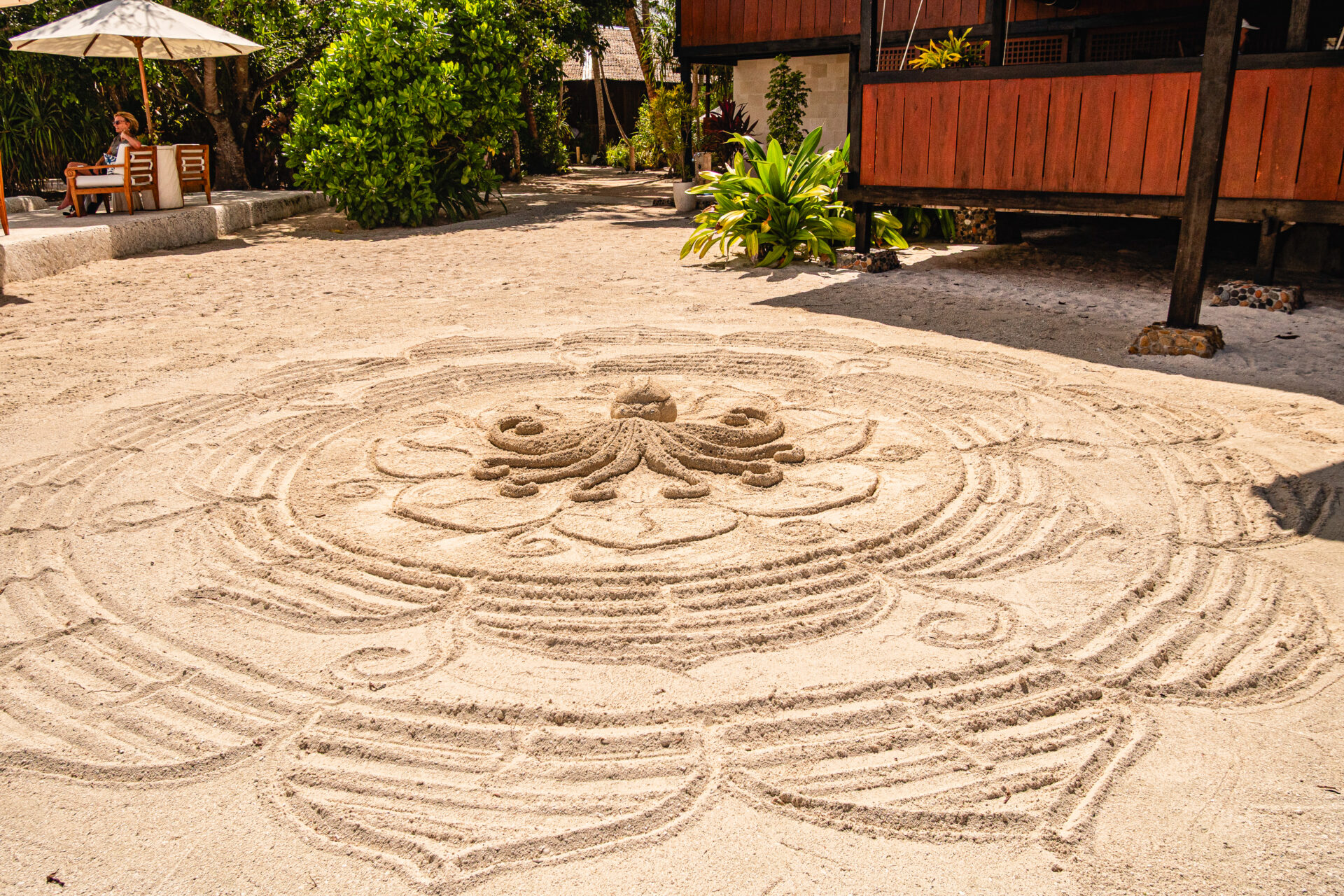
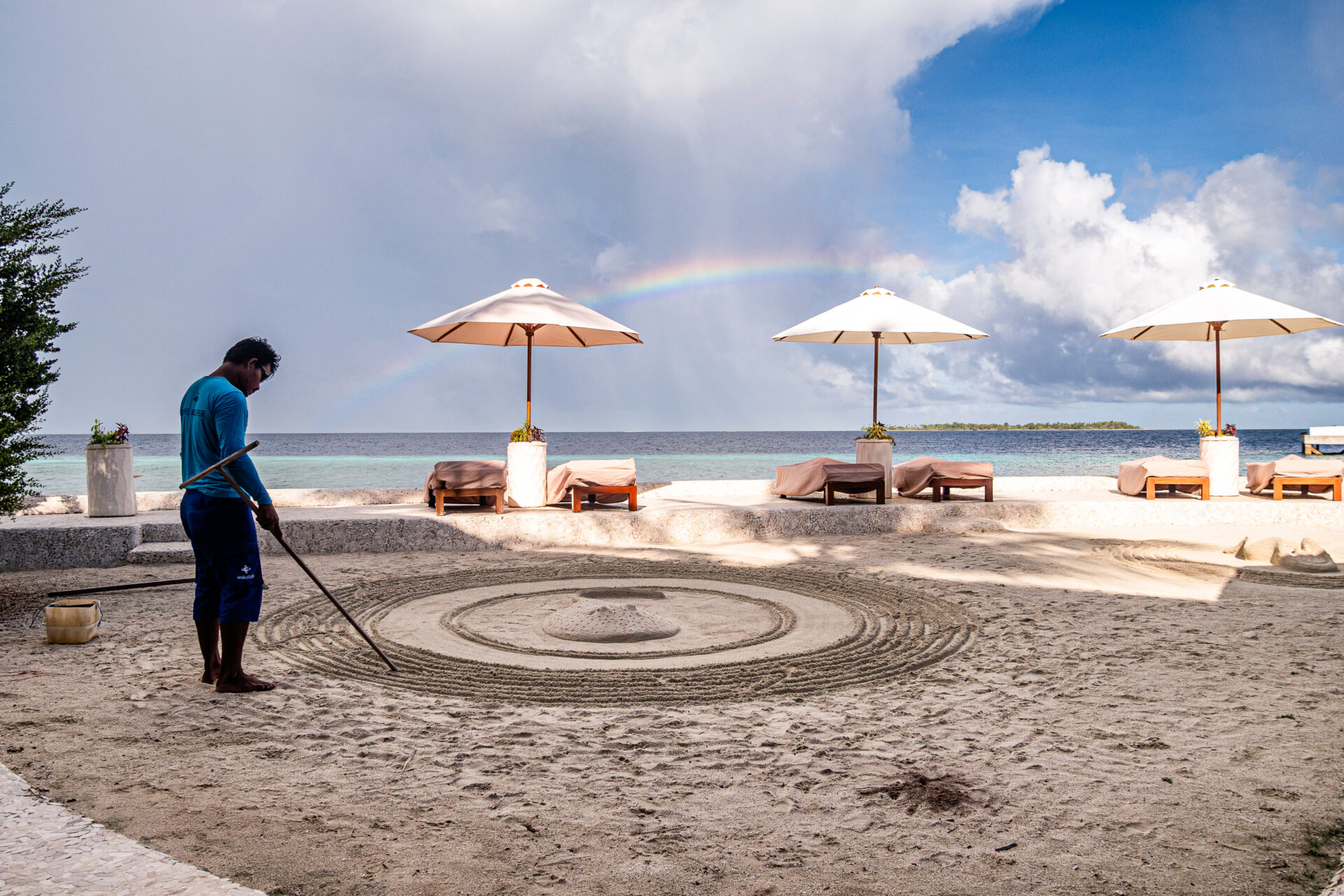
And for thirty years to date, guests have praised Wakatobi. Take a browse through guest testimonials and a pattern quickly emerges: beyond the frills, people remember the people. They remember their dive guide who listened carefully to their every preference. They remember the gardeners who greeted them each morning before their dives, tracing intricate mandalas into the sand. They remember how their favourite morning ritual appeared at the dining table before it was ever requested. They remember how the warmth of a genuine smile, in a remote corner of Indonesia, made the world feel smaller and kinder. It is this intangible quality that so many of us have come to describe as The Spirit of Wakatobi.
This recent testimonial captures it well:
“Another wonderful week at Wakatobi. A huge thank you to each and every staff member — always a welcoming smile, generous of spirit, and helpful in every way. For Muji and Juliet, their guiding and knowledge is remarkable. Such good company, and so much laughter. See you same time next year!” — Roger and Dianne Hall, guests since 2024, returning annually
It is without question that guests of Wakatobi experience the resort’s finished production: the seamless travel arrangements, the art of service, the choreographed diving experience, and the lasting relationships that make every guest feel like family. What they rarely glimpse are the people behind the scenes – those whose long commitment have shaped this place since 1996.
As Wakatobi marks its 30th anniversary in 2026, the people behind its legacy deserve more than a footnote. Much of the applause, after all, belongs to them. Here are their reflections.
Act One: The Dive Experience Managers
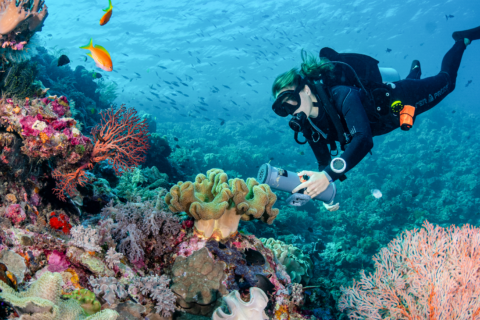
To be considered for a place on Wakatobi’s dive team, a candidate must have logged a minimum of 1,000 dives. Do the math, and you’ll find that some of Wakatobi’s Dive Experience Managers – DEMs, as they’re known on the island – have surpassed 15,000. To understand how, one must consider the role. Most guides spend roughly nine months of the year on site, working five to six days per week and complete three or four dives per day. For a passionate diver, a day spent almost entirely at sea is the whole point. Dive times at Wakatobi are notably generous, with many guests regularly reaching seventy minutes. At a conservative average of sixty minutes per dive, one Wakatobi guide who has logged 15,000 dives has spent the equivalent of nearly two years continuously beneath the surface.
Nobody here counts it. It’s just the shape of the work.
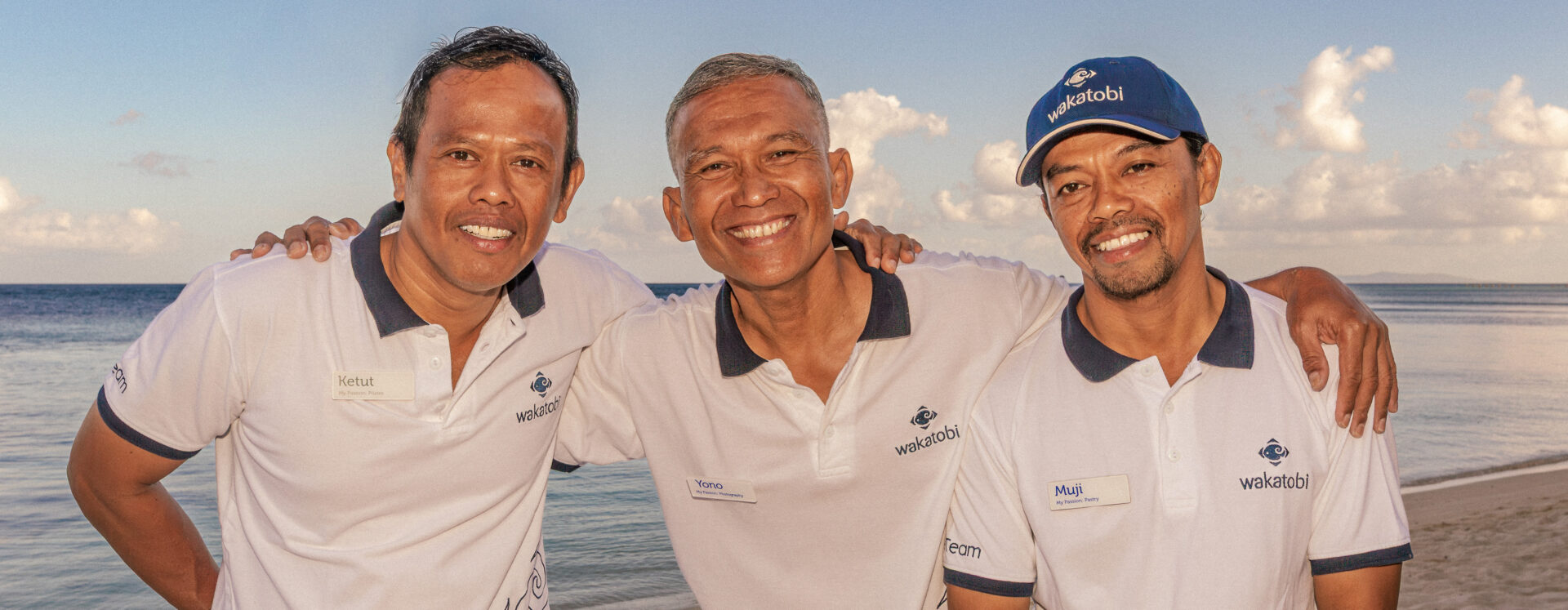
Two of them, Yono and Muji, have given the better part of their careers to Wakatobi. Yono has been with the resort for over fifteen years. Muji recently marked his eighteenth year, though his path to the water was not so linear. He began working for Wakatobi in the dining room, until his curiosity for the water grew strong. He decided one day to try out diving for himself. That was that.
Alongside fellow DEM Ketut, Yono and Muji are part of the dive team many guests come to know by name.
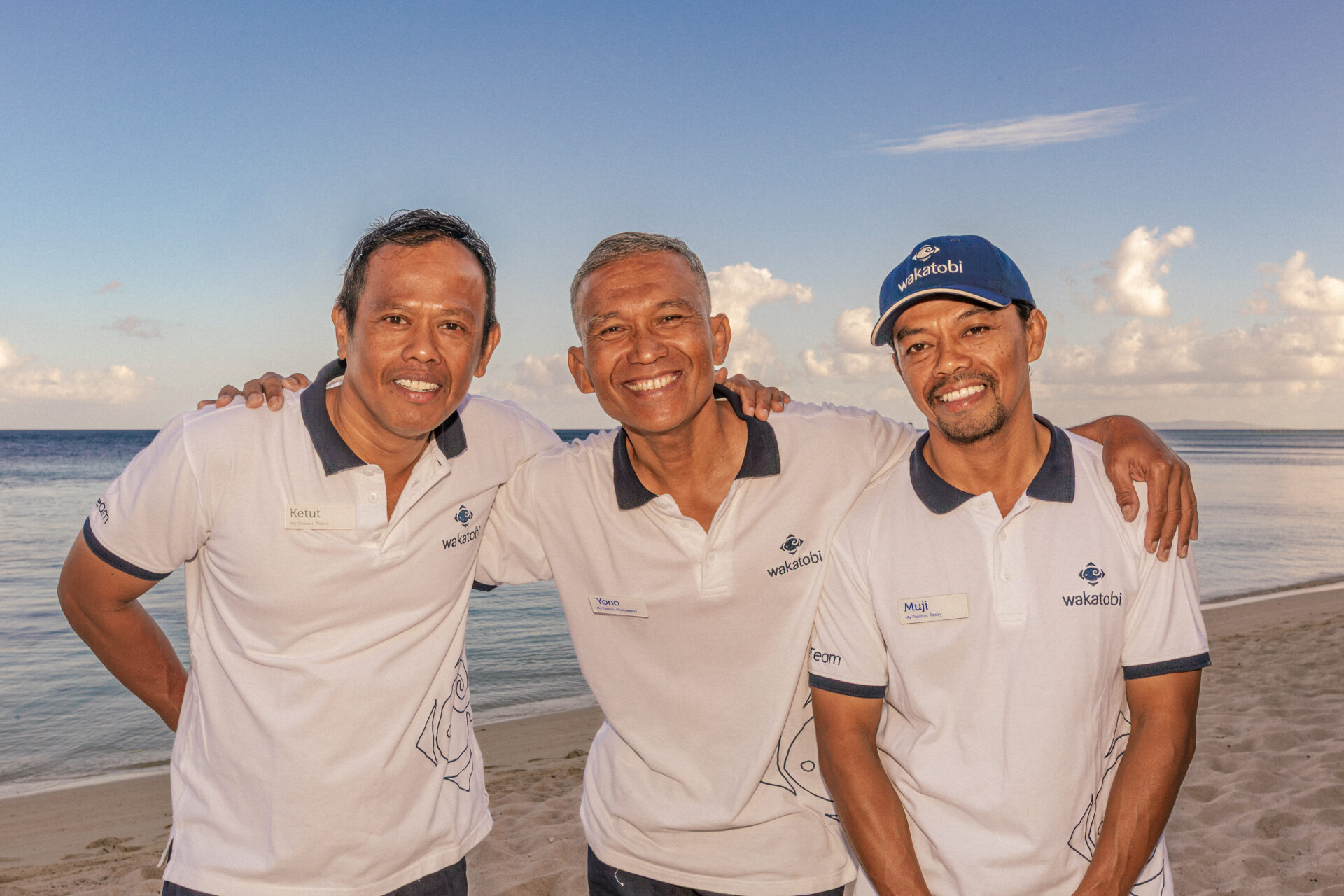
Their longevity has not gone unnoticed. At dive shows and travel gatherings around the world, I tend to hear a particular kind of conversation that resurfaces over and over. “Next time I visit, I’d love to dive with Yono again.” Or, with a mix of nostalgia and hope: “Muji was my guide fifteen years ago! Is he still there?”
He is. They both are. And for many returning guests, these characters play a significant part of why they come back. For Muji, his role carries a responsibility that extends beyond the dive briefing.
“All the guides at Wakatobi play a role not only as reef spotters, but as guardians. We help keep our ocean clean and our reefs healthy. Wakatobi is not purely a business. It cares for the local elders, and in return, the communities help us protect the reef,” says Muji.
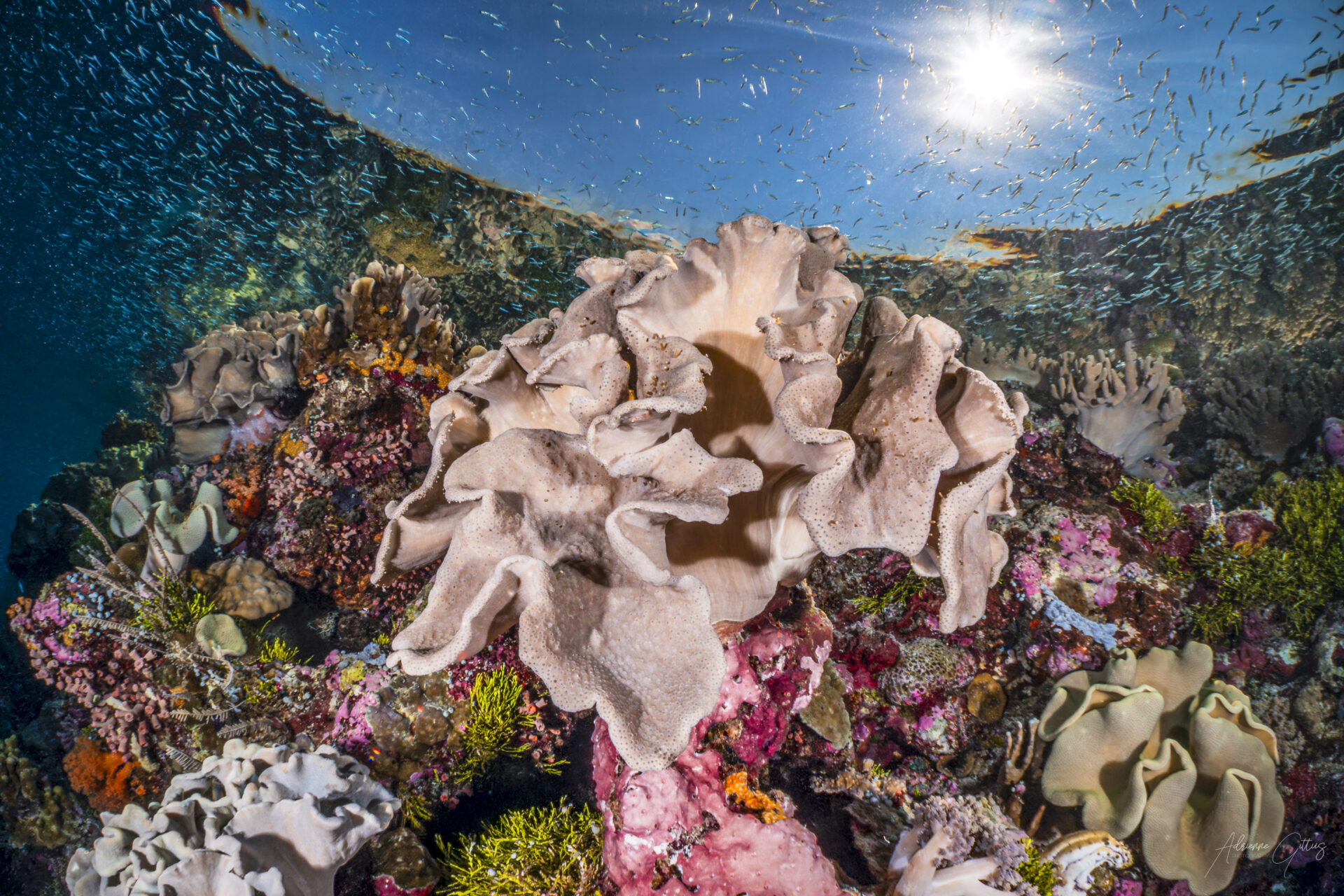
Yono speaks of his work with the same quiet conviction: “Wakatobi is more than a place to work. It has given me the opportunity to learn about marine life, conservation, and the underwater world every single day.”
That learning has brought with it moments of rare beauty. One memory that sticks with Yono: a large school of roughly twenty eagle rays gliding in formation through Turkey Beach – a recollection of what three decades of marine protection can produce.
Act Two: The Restaurant Team
Dining room managers Adhi and Ibram, along with longtime team member Safar, represent a chapter of Wakatobi’s story that stretches back well over a decade for each of them. Adhi joined the resort in 2007. Ibram and Safar both arrived in 2011. Over these years, they have fed thousands of guests and remembered thousands of names and stories.
For guests, the restaurant is often where the most unexpected moments of connection occur. During my latest visit, Ibram, knowing I was from Texas, leaned over the dining table one evening and asked whether I had ever heard of George Strait or Waylon Jennings. I couldn’t help but smile. “Of course I have,” I told him. “What do you know about Amarillo by Morning?”
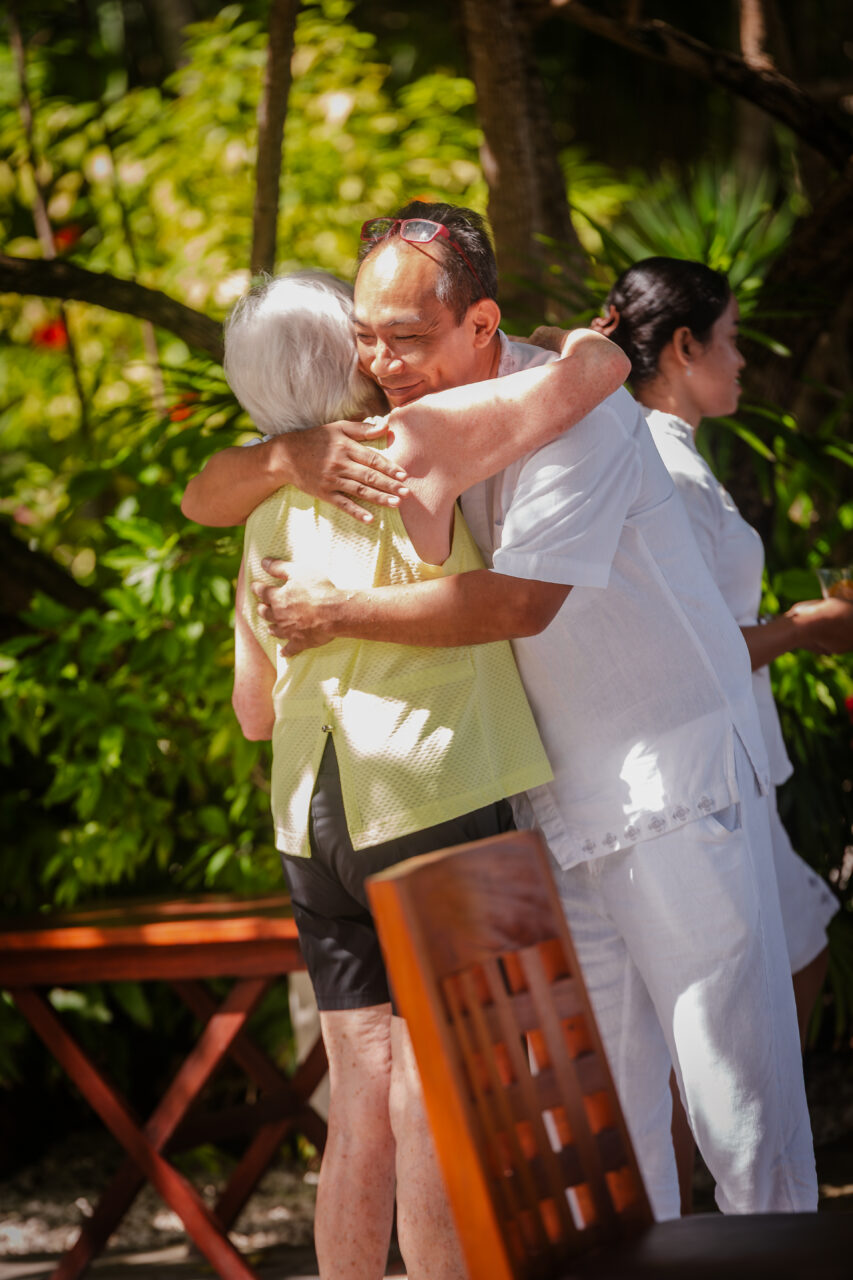
What followed was one of those conversations that caught me completely off guard. The kind you don’t expect to have halfway around the world, on a tiny remote island of Indonesia, and yet somehow feel entirely at home in. I’ve already made a mental note to bring him a Stetson on my next visit. A small gesture between two self-declared cowboys separated by several thousand miles of ocean.
It is precisely that same kind of attention that Adhi has championed throughout his time at Wakatobi.“We want guests to remember that they weren’t just a room number. They were our honored guest, and we paid attention,” says Adhi.
For Safar, who grew up on neighbouring Tomia Island, the significance of Wakatobi runs deep. Over fifteen years, he has watched the resort create meaningful opportunities for local families, improve village infrastructure, and inspire a broader culture of environmental stewardship throughout the region. Years of daily conversation with guests from around the world gave him something he didn’t expect: English, picked up across the dining room rather than in any classroom.
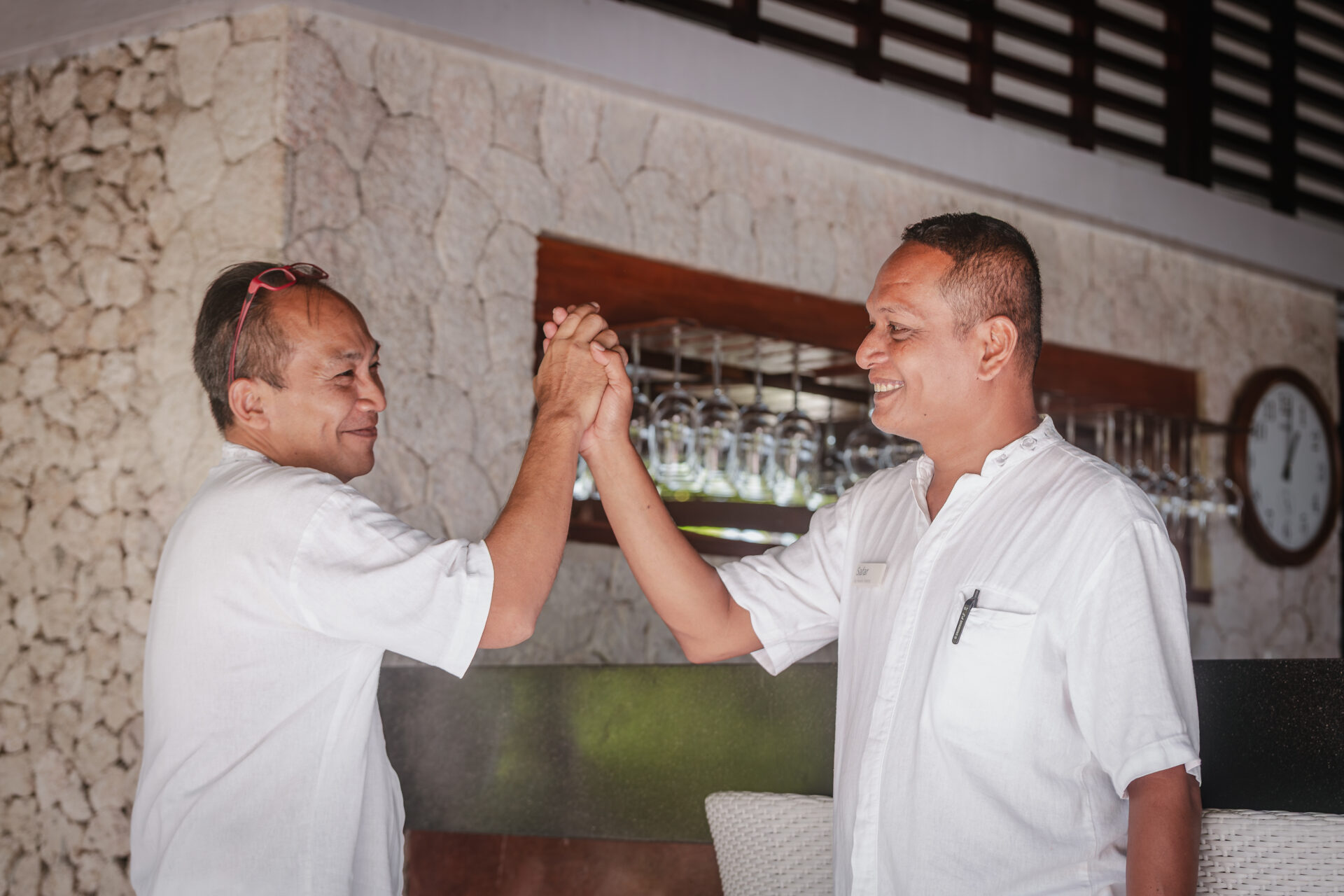
Years of daily conversation with guests from around the world gave him something he didn’t expect: English, picked up across the dining room rather than in any classroom.
Call them hospitality professionals and you’d be selling them short. Together, these three men are continuity personified. They’re the reason a guest who came once comes back, and back again – the through-line from the resort’s first years to now.
Act Three: The Ones Who Built It
Some of Wakatobi’s longest-serving staff members work largely out of sight, yet their fingerprints are everywhere.
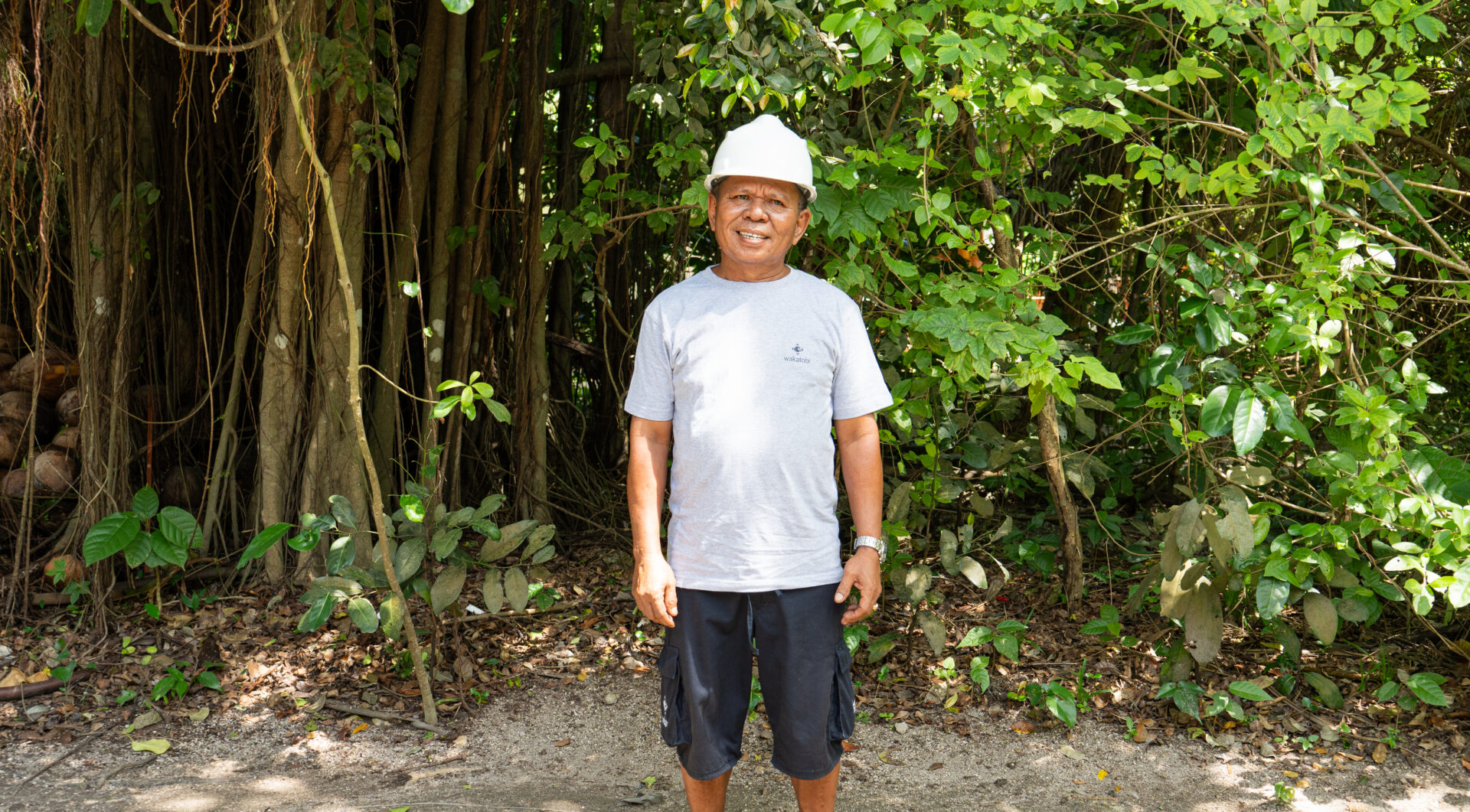
When Suhartono, known to everyone as Bondo, arrived from Lamanggau in June 2000, he was tasked with building and leading a team of skilled cement workers responsible for the resort’s masonry, concrete, bricklaying, and tile work. Over the years, his craftsmanship has shaped nearly every corner of Wakatobi.
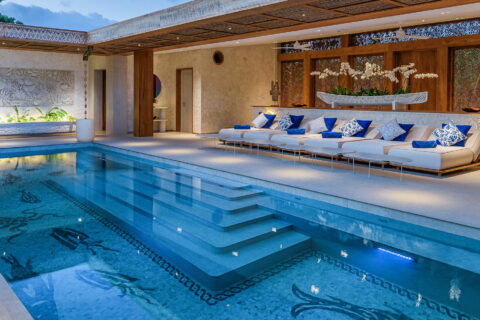
Today, Bondo oversees construction across the entire resort, having contributed to the airstrip, swimming pools, and the new Courtyard Residence, where he personally supervised the stonework and atrium tile. “The building,” he says, “never stops.”
What drives him runs deeper than concrete and tile. He has watched the surrounding communities transform – roads built, electricity established, education made accessible to families who once couldn’t afford it. Two of his own children are now in college. “Wakatobi has lifted the island’s welfare,” he says. For Bondo, that is not just a theory. It is his family’s story.
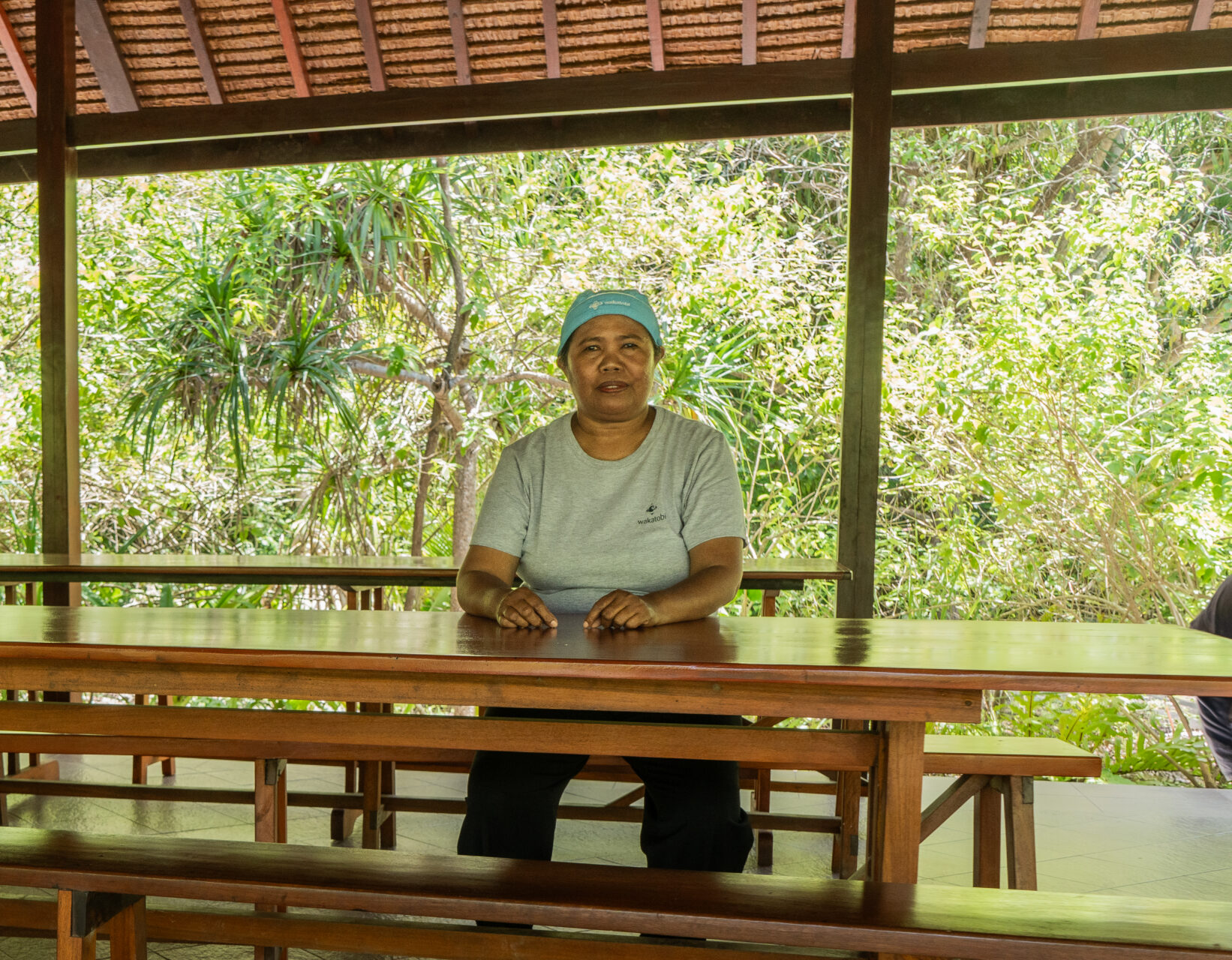
Sumarani – known as Adele – arrived even earlier than Bondo in March of 1998, when just fifteen people worked the entire island and the resort was little more than a Longhouse on a remote shore. She moved through every department before eventually finding her place leading the staff canteen, where she now cooks daily meals for the hundreds of people who keep Wakatobi running. She had no formal culinary training when she started. What she has now, she learned alongside colleagues over nearly three decades.
Her investment in Wakatobi is personal in every sense. Her brother serves on the reef patrol team. She has encouraged her relatives to stop fishing from the sea, because she understands the value of keeping the fish in the water. When asked about retirement, she doesn’t hesitate. “Even if I retire, if the company still needs me, I am here,” she says.
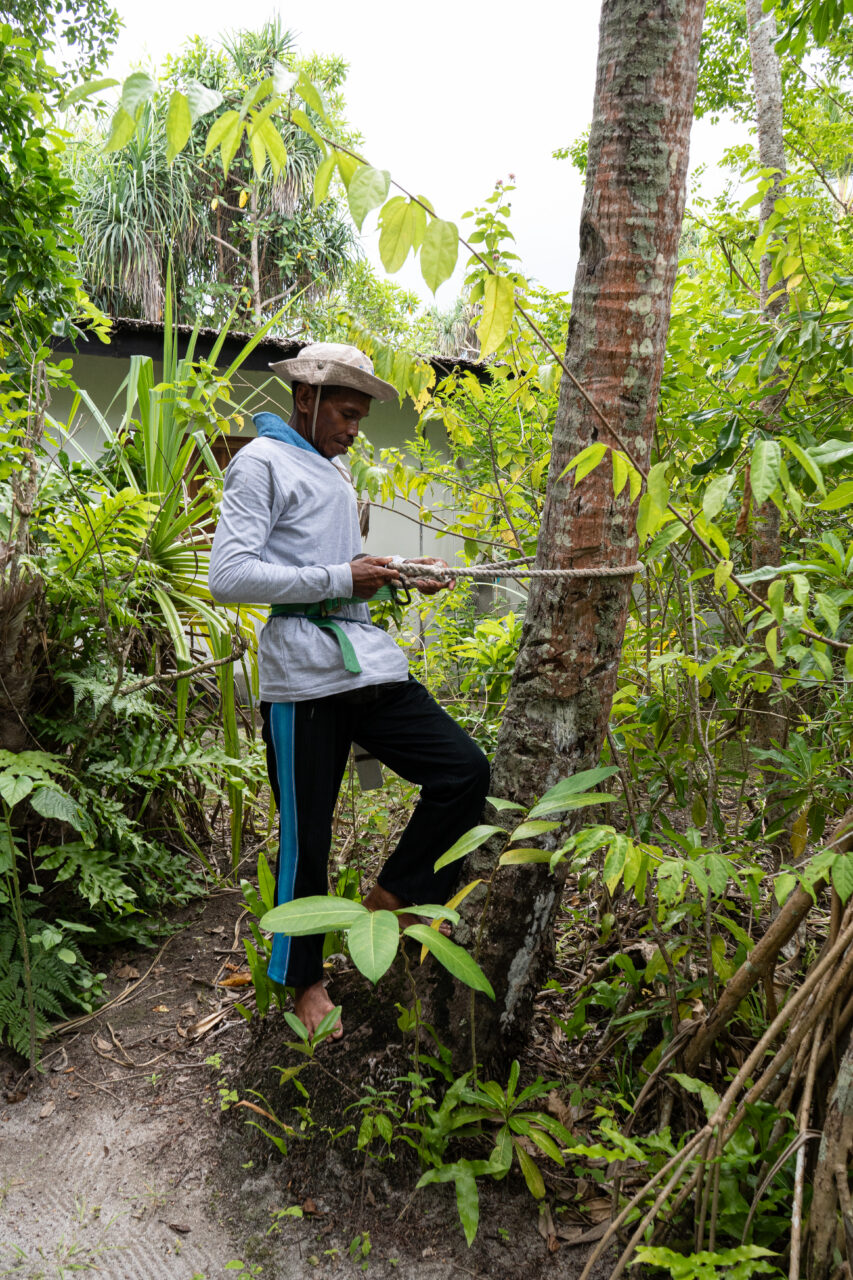
Gardener Madipili has been shaping Wakatobi’s landscape since 2007, and the island looks nothing like it did when he arrived. Much of that is his work – trees and plantings brought in from beyond the island, layered over years into the lush environment guests move through today.
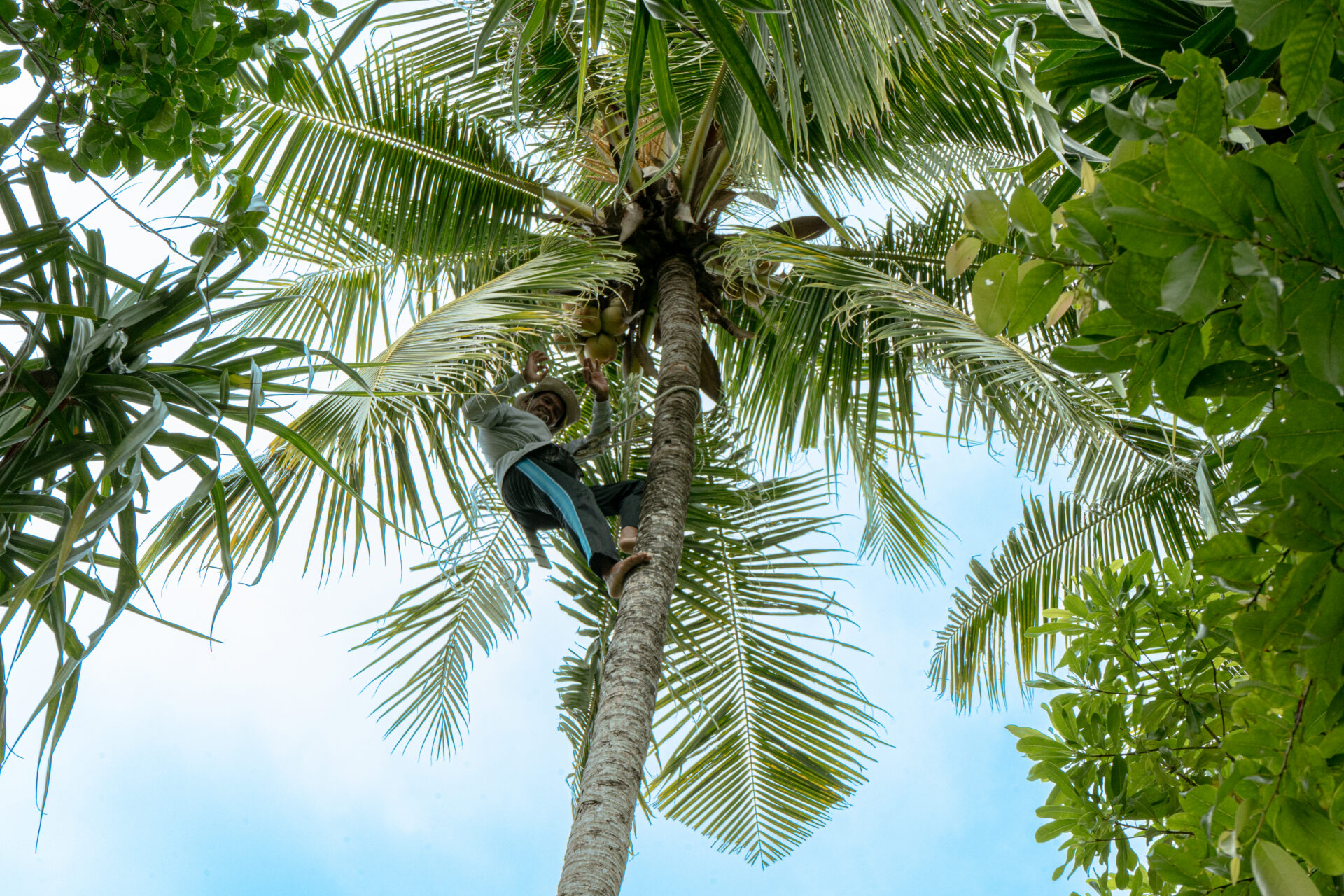
Madipili is, by his own account, happiest when interacting with guests. When I sat down to speak with him, he offered almost immediately to climb a nearby palm for photographs. Before I could fully process the offer, he was already on the tree – scaling forty feet of trunk with a machete at his side, moving upward with a speed and ease that made it look entirely unremarkable. At the top, he swung the machete and sent a coconut tumbling to the ground below. He descended just as deliberately, split the coconut open on the spot, and handed it to me. Coconut water as fresh as it gets, offered with the quiet satisfaction of someone who has always understood that the best hospitality is the kind that doesn’t announce itself.
Like Bondo, Madipili’s roots here run through his family. His sister-in-law and nephew also work at the resort. His oldest son has graduated from college and is now working in Bali. Another is training to become a dive guide. Before Wakatobi, the island ran on fishing – income that was unpredictable and seasonal. Now there is a fixed salary, and with it, the ability to plan.
Before Wakatobi, the island ran on fishing — income that was unpredictable and seasonal. Now there is a fixed salary, and with it, the ability to plan.
Act Four: A Witness to the Beginning
Few people have watched Wakatobi’s story unfold as closely as Tomi. Fewer still helped write its earliest chapters.
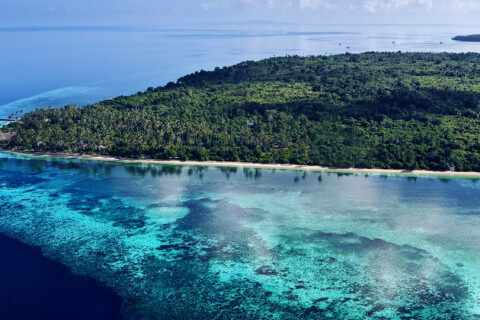
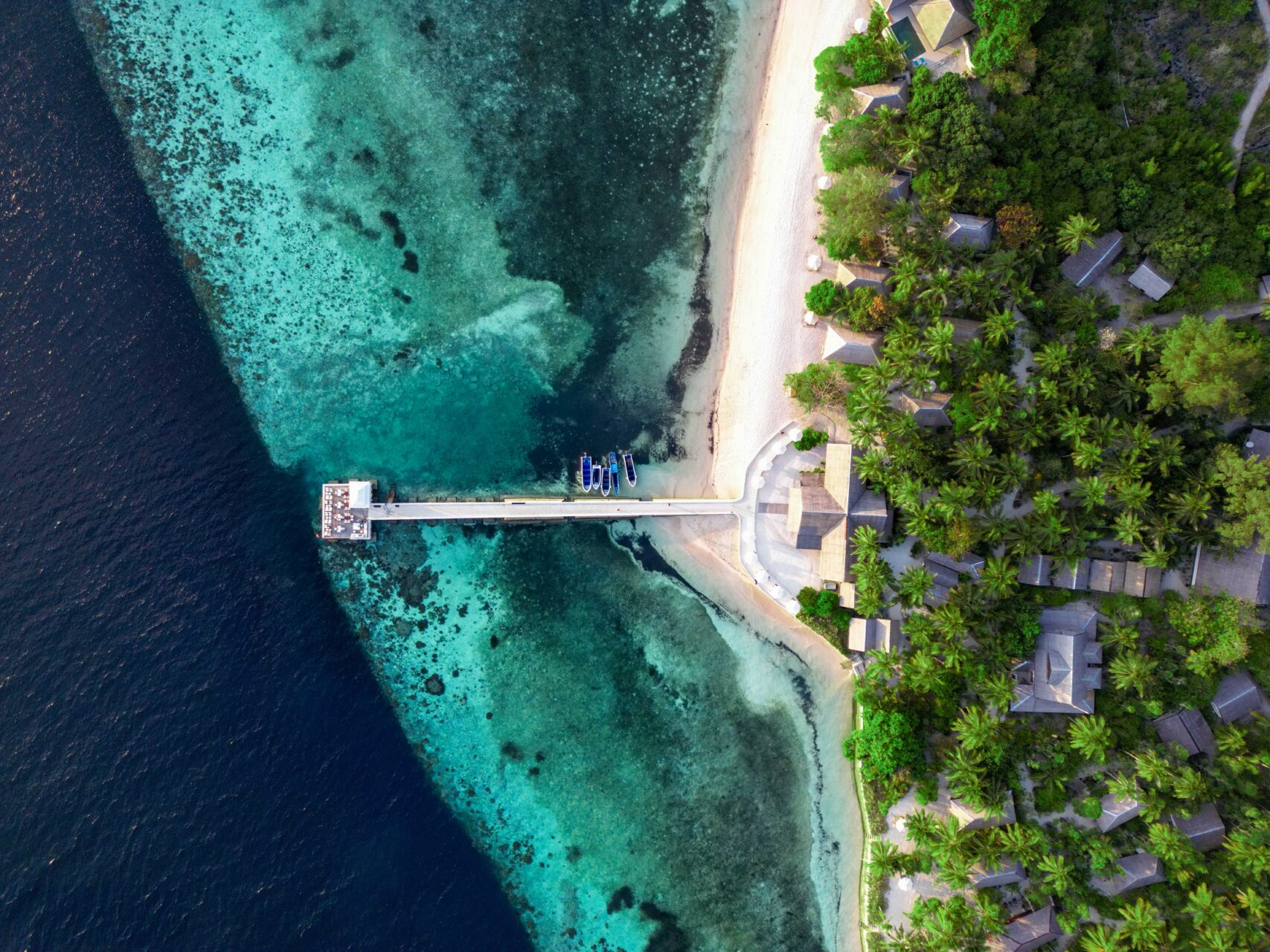
Tomi joined the project in 1995, before the resort had welcomed a single guest, as one of its first three employees. He helped construct the original Longhouse and Jetty, and in the earliest days transported guests by boat from Buton – a journey that once took nearly twenty hours. Today those same guests arrive on a direct flight from Bali, landing on a private airstrip that didn’t exist when Tomi began. It is a transformation he still quietly marvels at.
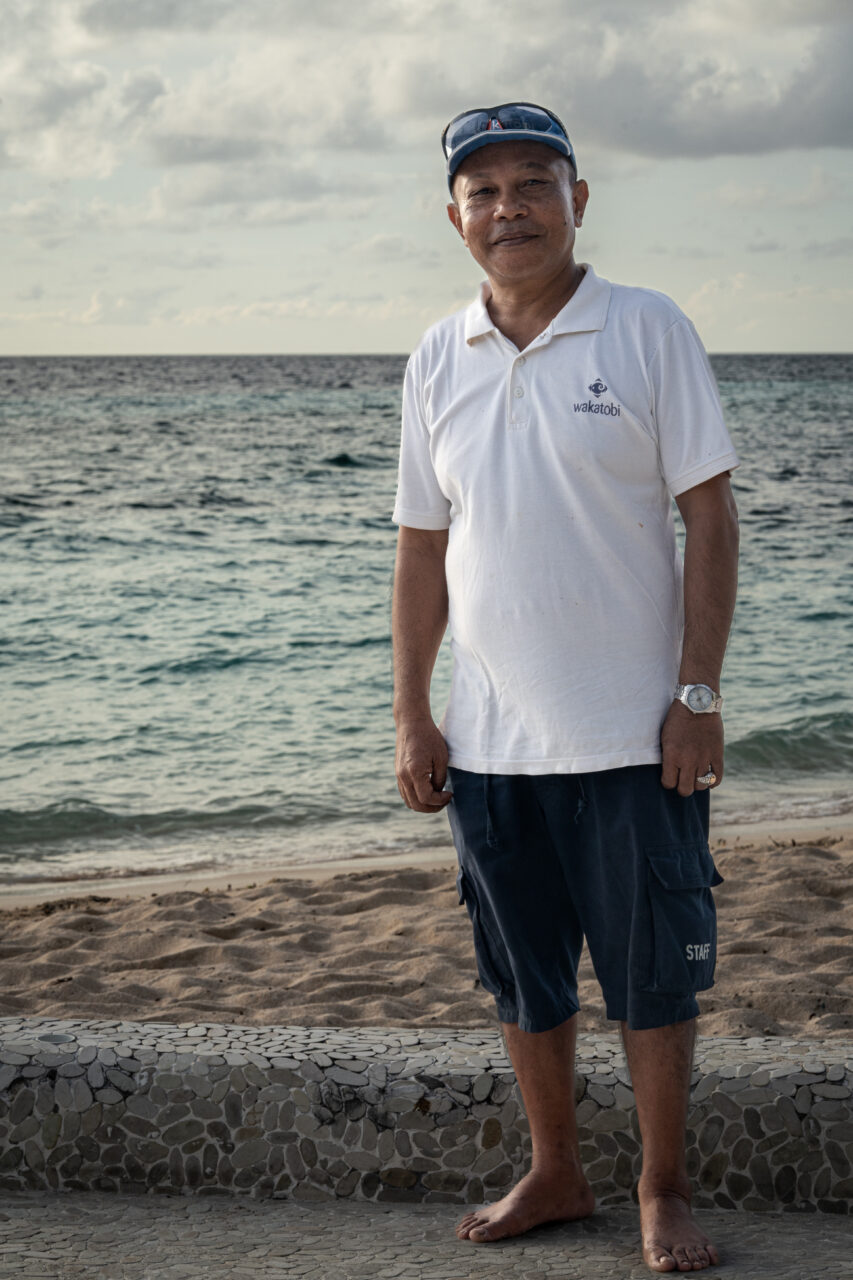
He [Tomi] helped construct the original Longhouse and Jetty, and in the earliest days transported guests by boat from Buton — a journey that once took nearly twenty hours. Today, those same guests arrive on a direct Wakatobi guest flight from Bali, landing on a private airstrip that didn’t exist when Tomi began.
But Tomi’s role has never been purely operational. From the beginning, Wakatobi’s founder Lorenz Mäder, entrusted him with something far more delicate – helping establish the original lease agreements between the resort and the surrounding villages. As Lorenz’s closest confidant, Tomi became the bridge between a foreign founder’s vision and the communities whose cooperation would determine whether that vision could endure. For now more than thirty years, he has remained at that bridge. “Wakatobi isn’t just a business. It is a conservation project, and one that will continue to grow,” says Tomi.
Act Five: Caring for the Next Generation
For many families visiting Wakatobi, Jarida is one of the first people their children come to know. Often, she is one of the last they want to say goodbye to.
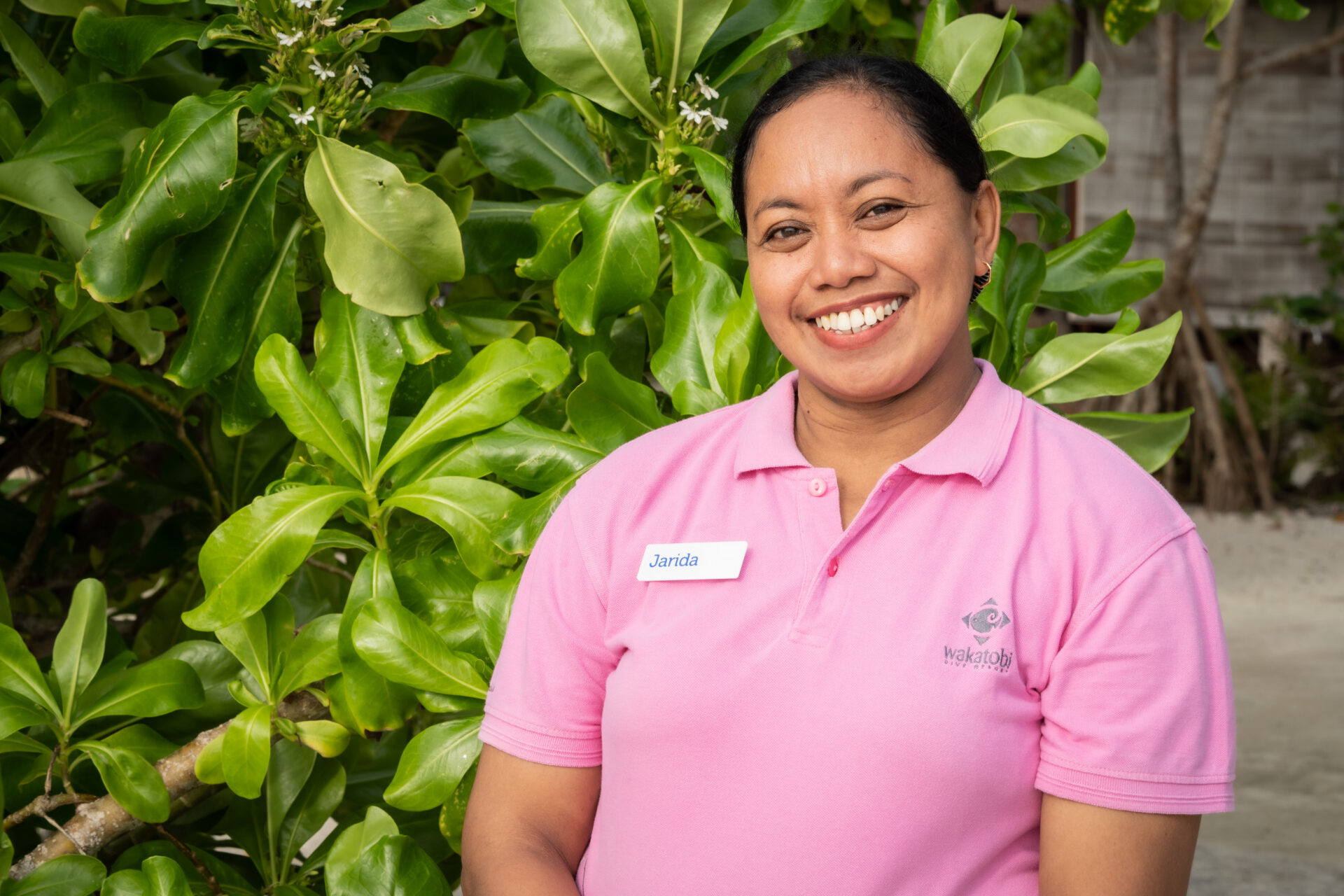
Since joining the resort in 2011, she has cared for countless young guests through Wakatobi’s Kids Club, creating a space where children feel safe, genuinely seen, and free to simply be children. She has watched families return year after year, their kids growing taller each time. She helped care for the children of Wakatobi’s own founders, some of whom are now young adults – a detail that speaks to both the resort’s legacy and the quiet depth of trust placed in her. When asked what Wakatobi means to her, she paused. Then her eyes filled with tears. Some answers run deeper than words. Hers was one of them.
Curtain Call
Every performance eventually ends. The lights turn back on, the curtain falls, and the audience returns to ordinary life – carrying with them whatever the experience gave them.
What Wakatobi’s guests carry home, more often than not, is not just the memory of a healthy reef. It is the memory of people. Of Muji’s quiet pride in a healthy coral head. Of Safar learning the name of a guest in a language not his own. Of Bondo, who helped build this place with his hands and whose fingerprints will remain. Of Tomi, who understands that conservation only endures when a community chooses it for itself.
Thirty years in and the production is still running. The cast has grown, the protected area has expanded, and the guests keep returning – not because Wakatobi asks them to, but because some places are simply hard to leave behind.
If you haven’t been, the story is still unfolding. There is still time to be part of it.
To begin planning your stay, email office@wakatobi.com or complete a quick trip enquiry.
Explore The Courtyard Residence at Wakatobi and follow us on Facebook and Instagram.